
There’s a particular kind of warmth that washes over you when you stumble across The Little Rascals on a lazy weekend afternoon. Released in 1994 and directed by Penelope Spheeris, the film took the beloved Our Gang shorts of the 1920s and ’30s and reimagined them for a new generation of kids—and it succeeded so thoroughly that an entire generation now feels a pang of nostalgia at the mere mention of “He-Man Woman Haters Club.”
A Sandlot Full of Mischief
The plot is simple, and that’s the point. Spanky (Travis Tedford), the no-nonsense leader of a boys-only clubhouse, faces a crisis when his best racer and second-in-command, Alfalfa (Bug Hall), falls head over heels for the lovely Darla (Brittany Ashton Holmes). Romance, after all, violates the sacred bylaws of the He-Man Woman Haters Club. What follows is a series of escapades—a soapbox derby race, a talent show disaster, a burned-down clubhouse, and the eternal war between boys who think girls have cooties and a boy who has discovered otherwise.
It’s a film built on pure childhood logic, where the biggest stakes in the world are a go-kart race and the most dangerous threat is a kiss. For adults watching today, that simplicity is exactly the medicine we didn’t know we needed.
The Faces We Never Forgot
Part of the movie’s enduring charm lies in its unforgettable cast of characters, each one a vivid cartoon brought to life. There was Alfalfa with his iconic cowlick sticking straight up like an antenna, forever serenading Darla in that warbling, off-key voice. There was sweet, freckled Darla herself, the object of his affection. Spanky anchored the group with his deadpan authority, while little Porky and his constant companion Buckwheat delivered some of the film’s most quotable moments (“O-tay!”).
And of course, who could forget Petey, the dog with the perfect ring painted around one eye—a nod to the original Our Gang canine that connected this 1994 reboot to its nearly seventy-year-old roots.
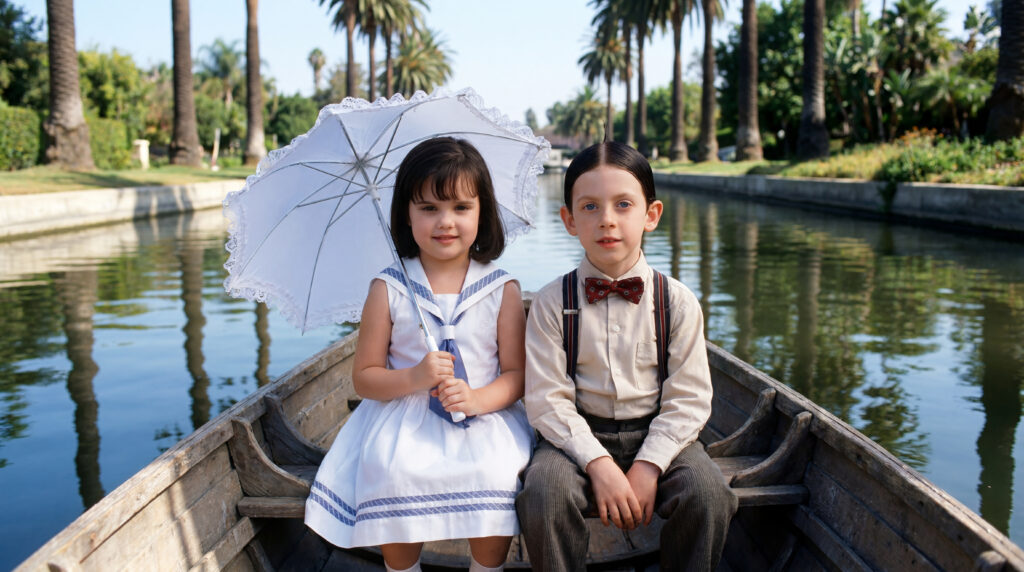
The famous rowboat scene, with Alfalfa and Darla drifting along beneath a lace parasol, remains one of the most tender and gently comic images of ’90s family cinema. It captured that first-crush feeling so perfectly that it became shorthand for puppy love itself.
A Bridge Between Generations
What made The Little Rascals special was its devotion to the source material. The original Our Gang shorts, produced by Hal Roach beginning in 1922, were groundbreaking for showing children of different backgrounds simply being kids together. Spheeris’s film honored that spirit, lifting gags, character names, and even entire bits from the old reels and dusting them off for a generation raised on VHS tapes.
For many American kids of the ’90s, this movie was their first introduction to a piece of film history that their grandparents had grown up with. It was a rare cultural handoff—a story that parents and children could love for entirely different reasons.
Why It Endures
Thirty years on, The Little Rascals occupies a tender corner of the millennial heart. It wasn’t a critical darling—reviews at the time were lukewarm—but critical consensus has never been the measure of a comfort film. The movie earned a healthy box office and, more importantly, a permanent place in the rotation of sleepover staples and rainy-day rewatches.
There’s something reassuring about returning to a world where problems are solved by the end of the afternoon, where loyalty and friendship win out, and where the worst betrayal imaginable is your buddy falling in love. In an era of increasingly complicated entertainment, the film’s earnest simplicity feels almost radical.
Maybe that’s the real secret to its staying power. The Little Rascals doesn’t ask much of us. It just invites us back to a sun-drenched, scraped-knee version of childhood—one where the clubhouse always stands, the dog always finds his way home, and Alfalfa always, eventually, gets the girl.
And every time we hear that cracking, earnest voice attempt a love song, we’re seven years old again.