
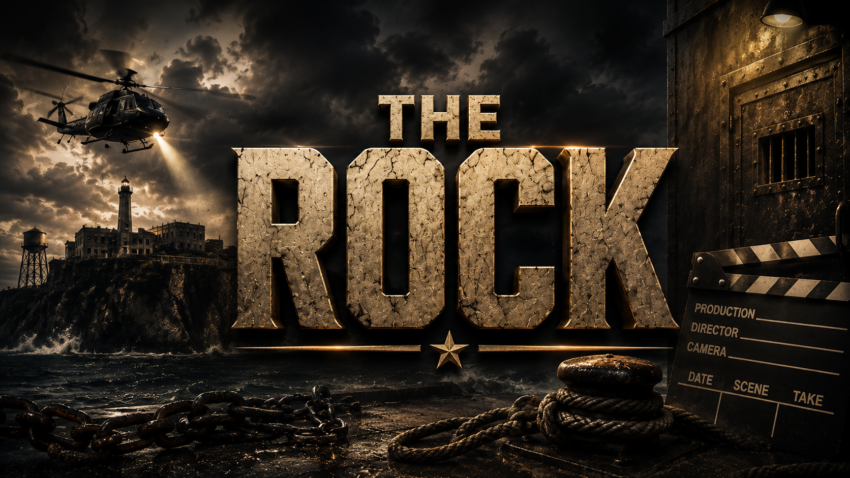
An unforgettable combination of Alcatraz, explosive action, memorable characters, and three commanding performances helped The Rock earn a lasting place in action cinema.
Few action movies capture the energy of 1990s Hollywood quite like The Rock. Directed by Michael Bay and released in 1996, the film brings together Sean Connery, Nicolas Cage, and Ed Harris for a high-stakes thriller built around one of America’s most recognizable locations: Alcatraz Island.
But The Rock is more than explosions, military operations, car chases, and spectacular set pieces. Its real strength comes from the contrast between its central characters, the tension of its isolated setting, and a story that continually pushes its heroes into increasingly dangerous situations.
That combination helped transform the film into a memorable example of big-screen action filmmaking.
What Is The Rock About?
The story begins with decorated Marine General Francis X. Hummel, played by Ed Harris, taking control of Alcatraz Island and holding civilians hostage.
His actions trigger a dangerous crisis that requires an unusual solution.
The authorities turn to Stanley Goodspeed, played by Nicolas Cage, an FBI chemical-weapons specialist whose expertise makes him essential to the mission.
There is one major problem: getting inside Alcatraz.
That is where Patrick Mason, played by Sean Connery, enters the story. Mason possesses knowledge of the prison that could provide the team with a way inside.
Goodspeed and Mason could hardly be more different. One is a nervous specialist thrown into an extraordinary field operation; the other is experienced, mysterious, confident, and extremely difficult to control.
Their uneasy partnership becomes the heart of the movie.
AFI credits Connery as Patrick Mason, Cage as Stanley Goodspeed, and Harris as General Francis X. Hummel.
Sean Connery Gives the Film Its Coolest Presence
Sean Connery brings enormous screen presence to Patrick Mason.
Rather than simply playing another conventional action hero, Connery gives the character intelligence, confidence, humor, and mystery.
Mason frequently appears to understand the danger before everyone around him does. His calm personality creates an effective contrast with Goodspeed’s nervous energy.
That difference produces some of the film’s most entertaining character moments.
Connery’s performance also gives The Rock a classic adventure quality that separates it from a straightforward military thriller.
Nicolas Cage Brings Energy and Humor
Stanley Goodspeed is not introduced as an unstoppable action hero.
That is precisely why the character works.
Nicolas Cage plays him as an intelligent specialist suddenly forced into circumstances far beyond his normal professional environment.
Goodspeed understands the scientific threat, but surviving an armed operation inside Alcatraz requires an entirely different kind of courage.
His reactions bring humor and unpredictability to the film without removing the danger surrounding him.
As the mission becomes increasingly desperate, Goodspeed has to adapt.
His transformation gives the story an effective human center.
Ed Harris Creates More Than a Simple Villain
General Hummel could easily have been written as a one-dimensional antagonist.
Instead, Ed Harris gives the character seriousness and emotional weight.
The film establishes motivations behind Hummel’s actions, creating a conflict that is more complicated than a simple battle between heroes and villains.
That distinction matters.
Hummel remains responsible for an extremely dangerous situation, yet the story allows the audience to understand what drives him.
Harris plays that conflict with restraint, giving the movie a stronger dramatic foundation beneath its spectacle.
Why Alcatraz Is the Perfect Setting
Alcatraz is not simply a background location in The Rock.
It is central to the movie’s identity.
The prison’s narrow corridors, aging structures, underground passages, cells, industrial spaces, and isolated position in San Francisco Bay naturally create tension.
Once the operation begins, the location turns into a maze.
Characters cannot simply walk away from danger.
Every corridor can become a trap, and every locked passage can create another obstacle.
The setting gives the film a physical personality that would have been difficult to reproduce with an ordinary fictional military facility.
Michael Bay’s High-Energy Direction
The Rock was directed by Michael Bay, with cinematography by John Schwartzman and editing by Richard Francis-Bruce. AFI also credits Jerry Bruckheimer and Don Simpson as producers.
Many visual qualities later associated with Bay’s action filmmaking are already clearly visible here.
The camera rarely allows the movie to feel static for long.
Large establishing shots are followed by intense close-ups. Fast action is balanced against dramatic character confrontations. Vehicles, military equipment, architecture, smoke, lighting, and movement are used to make the movie feel larger than its basic premise.
Yet the film still leaves enough room for its three central performances to matter.
That balance is one of its greatest strengths.
The Chemistry Between Connery and Cage
Perhaps the movie’s most important ingredient is the relationship between Patrick Mason and Stanley Goodspeed.
They are not traditional partners.
Mason is composed and experienced.
Goodspeed is intelligent but initially uncomfortable with the dangerous world into which he has been thrown.
The film repeatedly places them in situations where each man possesses something the other needs.
Goodspeed has specialized scientific knowledge.
Mason understands survival, infiltration, and Alcatraz.
Their differences generate both tension and comedy while allowing the partnership to develop naturally.
Without that chemistry, The Rock would still contain impressive action sequences.
With it, the movie becomes far more memorable.
Action With Real Stakes
The movie understands that spectacular action works best when audiences understand what could be lost.
The Alcatraz crisis creates a clear deadline and confines much of the danger to a recognizable location.
The characters cannot afford endless mistakes.
That urgency gives the major action sequences purpose rather than presenting explosions simply for spectacle.
Each escalation makes Goodspeed and Mason’s mission more difficult and pushes the story closer to disaster.
A Distinctive 1990s Action Movie
The 1990s produced many ambitious Hollywood action films, but The Rock developed a particularly recognizable identity.
It combines several genres at once:
Military thriller. Prison infiltration story. Buddy adventure. Action spectacle. Character drama.
Those ingredients could easily have produced an overcrowded movie.
Instead, they reinforce one another.
The serious conflict involving Hummel provides dramatic weight. Mason brings mystery and charisma. Goodspeed brings vulnerability and humor. Alcatraz supplies atmosphere. Michael Bay supplies scale and momentum.
Together, they create a film that feels unmistakably like a product of its era without depending entirely on nostalgia.
The Cast Behind The Rock
The three central performances dominate the film, but the supporting cast also strengthens its world.
The American Film Institute lists Sean Connery as Patrick Mason, Nicolas Cage as Stanley Goodspeed, Ed Harris as General Francis X. Hummel, Michael Biehn as Commander Charles Anderson, and William Forsythe as Eddie Paxton among the credited cast.
The military and government characters surrounding the central trio help make the crisis feel larger than the experiences of Mason and Goodspeed alone.
The Music Adds Scale
Music is another important part of the movie’s identity.
AFI credits Nick Glennie-Smith and Hans Zimmer for the film’s music.
The score supports both the military atmosphere and the film’s larger-than-life action.
During major sequences, the music helps transform the confined geography of Alcatraz into something that feels enormous.
That combination of image, editing, sound, and score contributes significantly to the film’s cinematic personality.
Why The Rock Still Works
Technology changes.
Action filmmaking changes.
Audience expectations change.
But strong character dynamics remain effective.
That is one reason The Rock continues to be an interesting film to revisit.
Its spectacle is important, but the movie does not rely on spectacle alone.
Audiences have Mason’s mysterious confidence, Goodspeed’s transformation under pressure, Hummel’s moral conflict, and the constantly evolving relationship between the central characters.
The action works because those characters give it context.
The Legacy of The Rock
The Rock represents a particular style of large-scale Hollywood action filmmaking: practical locations, charismatic stars, a straightforward high-concept premise, aggressive pacing, memorable music, and enormous cinematic energy.
Michael Bay would go on to direct much larger productions, while Nicolas Cage, Sean Connery, and Ed Harris each brought extensive careers and distinctive screen identities to the project.
Yet the combination created here remains unique.
The movie does not need a complicated universe or an endless mythology.
It begins with a dangerous crisis, places memorable characters inside an extraordinary location, and continually raises the pressure.
Sometimes that is exactly what an action movie needs.
Final Thoughts
The Rock remains a compelling example of how casting, location, character chemistry, and confident direction can elevate a straightforward action premise.
Sean Connery provides charisma and mystery. Nicolas Cage gives the story nervous energy, humor, and humanity. Ed Harris supplies dramatic weight. Michael Bay surrounds them with the scale and momentum of a major Hollywood action production.
And at the center of everything stands Alcatraz.
That combination gave The Rock an identity of its own—and explains why the film continues to stand out