
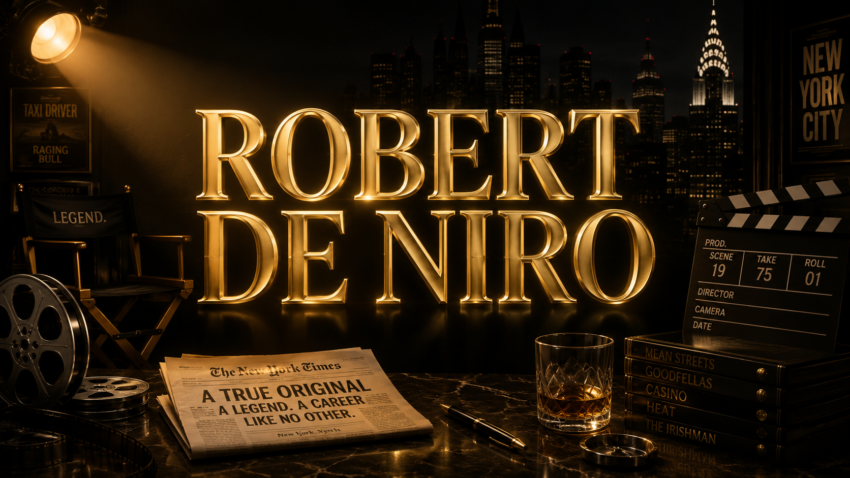
Robert De Niro stands among the most influential and recognizable actors in the history of American cinema. Across more than five decades, he has built a remarkable body of work through crime dramas, psychological character studies, gangster films, comedies, family movies and historical epics.
For many movie lovers, Robert De Niro is inseparable from characters such as the young Vito Corleone in The Godfather Part II, Travis Bickle in Taxi Driver, Jake LaMotta in Raging Bull, Jimmy Conway in Goodfellas and Sam Rothstein in Casino.
Yet focusing only on those celebrated performances would tell only part of his story.
De Niro has repeatedly reinvented himself. He moved from intense dramatic roles to comedy in films such as Analyze This and Meet the Parents. Decades after his first Academy Award, he returned to major awards recognition through Silver Linings Playbook and Killers of the Flower Moon.
His creative relationship with director Martin Scorsese also became one of the defining actor-director collaborations in cinema history. Together, they created films including Mean Streets, Taxi Driver, Raging Bull, The King of Comedy, Goodfellas, Cape Fear, Casino, The Irishman and Killers of the Flower Moon.
Beyond acting, Robert De Niro became a director, producer and one of the founders of the Tribeca Festival. His influence therefore extends beyond the characters he played and into the cultural life of New York City and modern filmmaking itself.
Who Is Robert De Niro?
Robert De Niro was born on August 17, 1943, in New York City.
His connection to New York would eventually become inseparable from his screen identity. Many of his greatest films are rooted in the city’s streets, neighborhoods, crime stories and complicated personalities.
The official Golden Globes profile for Robert De Niro records his New York birth and highlights his celebrated collaborations with Martin Scorsese, beginning with Mean Streets and continuing through several of the most important films of his career.
Before international fame arrived, De Niro studied acting seriously and gradually worked his way through stage productions and small film roles.
That disciplined approach to performance would eventually become one of the defining qualities of his career.
Robert De Niro’s Early Acting Career
De Niro did not become a major star immediately.
His early work included low-budget films and collaborations with filmmakers who were themselves still developing their careers.
One of the directors who worked with De Niro before his breakthrough was Brian De Palma.
The Golden Globes’ official career tribute notes that De Niro appeared in several low-budget films directed by De Palma before gaining wider critical attention.
Those early experiences gave De Niro time to develop a screen identity based less on conventional movie-star glamour and more on character transformation.
Bang the Drum Slowly
An important early step came with Bang the Drum Slowly in 1973.
De Niro played Bruce Pearson, a professional baseball player diagnosed with a serious illness.
The character required sensitivity and vulnerability rather than the aggression that would later become associated with several famous De Niro performances.
The role attracted critical attention and demonstrated that the young actor possessed substantial dramatic ability.
However, 1973 would become even more important because it also marked the beginning of one of cinema’s greatest creative partnerships.
Mean Streets and Martin Scorsese
Robert De Niro first worked with Martin Scorsese on Mean Streets.
The film starred Harvey Keitel as Charlie and De Niro as Johnny Boy, a reckless young man whose behavior creates constant danger for himself and the people around him.
Johnny Boy is unpredictable, arrogant and self-destructive.
De Niro’s performance has a raw energy that feels completely different from the controlled authority he would later display as Vito Corleone.
The Golden Globes identifies Mean Streets as the beginning of De Niro’s long series of collaborations with Scorsese.
Why the Scorsese Partnership Worked
Scorsese and De Niro shared an interest in complicated characters rather than uncomplicated heroes.
Their films frequently explore obsession, violence, masculinity, guilt, ambition and self-destruction.
De Niro was willing to transform physically and psychologically for roles.
Scorsese, meanwhile, created environments in which those transformations could become the center of a film.
The partnership eventually produced several performances that permanently changed the way De Niro was perceived as an actor.
The Godfather Part II
In 1974, Robert De Niro joined one of cinema’s most important franchises through The Godfather Part II.
Francis Ford Coppola cast him as the younger version of Vito Corleone, the character Marlon Brando had played in the original The Godfather.
The challenge was extraordinary.
De Niro had to portray a younger version of an already iconic character without simply imitating Brando.
Instead, he created a quieter and more restrained interpretation.
The young Vito begins as an immigrant attempting to survive and protect his family. Gradually, audiences watch him develop the influence, confidence and authority associated with the Corleone name.
Winning His First Academy Award
The performance earned Robert De Niro his first Academy Award.
The official Academy Awards database records De Niro as the winner of the Academy Award for Best Supporting Actor for The Godfather Part II.
The achievement immediately established him at the highest level of Hollywood acting.
More importantly, the performance became part of one of the rare cinematic situations in which two different actors won Academy Awards for portraying the same character at different ages.
Young Vito Corleone
De Niro’s version of Vito is especially memorable because of its restraint.
He rarely needs dramatic speeches to communicate authority.
Instead, power develops gradually through observation, patience and controlled action.
The character’s transformation is therefore subtle.
Audiences watch an immigrant father become the man who will eventually lead one of cinema’s most famous fictional families.
Taxi Driver
Two years later, De Niro reunited with Martin Scorsese for Taxi Driver.
He played Travis Bickle, a lonely Vietnam veteran working nights as a taxi driver in New York City.
Travis becomes increasingly alienated from the society around him.
His isolation gradually develops into obsession, anger and violent fantasies.
The performance became one of the defining achievements of De Niro’s career.
Travis Bickle and Psychological Isolation
Travis Bickle is not presented as a conventional protagonist.
He is disturbed, lonely and increasingly unreliable.
De Niro allows the audience to experience the world through Travis without asking viewers to approve of him.
That distinction gives Taxi Driver much of its psychological power.
Travis’s famous mirror scene also became one of the most recognizable moments associated with De Niro’s career.
Oscar Recognition for Taxi Driver
De Niro received an Academy Award nomination for Best Actor for Taxi Driver.
The Academy’s official database lists Travis Bickle among the performances that earned him Best Actor recognition.
The nomination confirmed that his Oscar victory for The Godfather Part II had not been a single breakthrough moment.
De Niro was becoming one of the central actors of his generation.
New York, New York
De Niro worked with Scorsese again in New York, New York, starring opposite Liza Minnelli.
The musical drama demonstrated another side of their partnership.
Instead of crime or psychological violence, the film explored music, ambition and complicated relationships.
Although it became less commercially celebrated than some of their other collaborations, it remains important because it demonstrates how willing both men were to experiment.
The Deer Hunter
In 1978, De Niro starred in Michael Cimino’s The Deer Hunter.
The film follows a group of Pennsylvania steelworkers whose lives are transformed by the Vietnam War.
De Niro played Michael Vronsky.
The character begins as part of a close community and returns from war deeply changed by what he has experienced.
The film is emotionally demanding, and De Niro’s performance depends heavily on restraint.
Another Academy Award Nomination
De Niro received another Best Actor nomination for The Deer Hunter.
The Academy Awards record confirms his nomination for the performance.
By the end of the 1970s, De Niro had already won one Oscar and received several additional nominations.
Yet one of his most demanding performances was still ahead.
Raging Bull
In 1980, De Niro reunited with Scorsese for Raging Bull.
He portrayed real-life boxer Jake LaMotta.
The performance became legendary not only because of De Niro’s acting but also because of the extraordinary physical transformation required for the role.
LaMotta is talented, aggressive and deeply self-destructive.
His inability to control jealousy and anger damages his relationships even as his boxing career brings professional success.
Robert De Niro’s Physical Transformation
De Niro became famous for the level of preparation he brought to Raging Bull.
He trained extensively to make the boxing sequences convincing.
Later, he changed his body dramatically to portray an older Jake LaMotta.
The transformation helped establish De Niro’s reputation as an actor willing to reshape himself completely for a character.
However, the physical changes would have meant little without the psychological performance beneath them.
Winning Best Actor for Raging Bull
De Niro won the Academy Award for Best Actor for Raging Bull.
The official Academy database records the victory.
It became his second Academy Award and his first in the leading actor category.
The performance remains one of the central reference points whenever De Niro’s acting legacy is discussed.
The King of Comedy
De Niro and Scorsese shifted into dark satire with The King of Comedy.
De Niro played Rupert Pupkin, an aspiring comedian obsessed with becoming famous.
Rupert is completely different from Travis Bickle or Jake LaMotta.
He is awkward, delusional and frequently embarrassing.
Yet beneath the comedy is another study of obsession.
The performance proved that De Niro could use many of the same qualities associated with his intense dramatic characters for something uncomfortable and darkly funny.
Once Upon a Time in America
In 1984, De Niro starred in Sergio Leone’s Once Upon a Time in America.
The sprawling crime epic follows several Jewish gangsters across decades of friendship, ambition, violence and regret.
De Niro played David “Noodles” Aaronson.
The role required him to portray a man shaped by memory and the consequences of a violent past.
The film became another significant entry in De Niro’s extraordinary collection of crime dramas.
The Mission
De Niro moved into historical drama with The Mission in 1986.
He played Rodrigo Mendoza, a mercenary and slave trader whose life changes after profound personal tragedy.
The character’s journey becomes one of guilt, redemption and spiritual transformation.
The American Film Institute continues to recognize The Mission as an important part of the filmography of its Life Achievement Award honoree Robert De Niro.
Midnight Run
In 1988, De Niro demonstrated his ability to handle comedy and action through Midnight Run.
He played bounty hunter Jack Walsh opposite Charles Grodin.
The film works largely because of the contrast between the two performers.
De Niro brings frustration and toughness, while Grodin’s character constantly challenges his patience.
The official Golden Globes page for Midnight Run records De Niro and Grodin as the film’s principal stars.
Goodfellas
In 1990, De Niro returned to gangster cinema with Scorsese’s Goodfellas.
He played Jimmy Conway, an experienced criminal operating alongside Henry Hill and Tommy DeVito.
Unlike some of De Niro’s more explosive characters, Jimmy often appears controlled.
That calmness makes him more unsettling.
The character understands patience, loyalty and violence as parts of the same criminal world.
Why Goodfellas Became a Landmark
Goodfellas transformed the gangster film by presenting organized crime with speed, humor and brutal unpredictability.
Ray Liotta’s Henry Hill guides the audience through the lifestyle, while Joe Pesci brings explosive danger as Tommy.
De Niro provides another type of menace.
Jimmy can seem relaxed even when the audience understands that something terrible may happen.
The Golden Globes’ Robert De Niro profile lists Goodfellas among the major films in his partnership with Scorsese.
Awakenings
Also in 1990, De Niro starred opposite Robin Williams in Awakenings.
He played Leonard Lowe, a patient affected by a neurological condition who temporarily regains movement and awareness through experimental treatment.
The performance required an entirely different physical and emotional approach from his crime roles.
De Niro communicates vulnerability, wonder and frustration through a character whose relationship with his own body is central to the story.
Oscar Nomination for Awakenings
The performance resulted in another Academy Award nomination for Best Actor.
The official Academy Awards database confirms De Niro’s nomination for Leonard Lowe.
The role remains important because it demonstrates that De Niro’s dramatic power was never dependent on aggression or intimidation.
Cape Fear
De Niro reunited with Scorsese in 1991 for Cape Fear.
He portrayed Max Cady, a convicted criminal seeking revenge against the attorney he believes failed him.
Cady is intelligent, physically threatening and psychologically relentless.
De Niro transformed his appearance and physical presence to make the character disturbing before he even speaks.
Another Oscar Nomination
His work in Cape Fear earned another Academy Award nomination for Best Actor.
The Academy officially records the nomination.
It became another example of De Niro’s willingness to make himself uncomfortable, physically and psychologically, for a performance.
A Bronx Tale
Robert De Niro moved behind the camera with A Bronx Tale in 1993.
The film marked his feature directing debut.
De Niro also played Lorenzo, a hardworking father trying to prevent his son from being drawn into organized crime.
The movie offers an interesting contrast with De Niro’s many gangster performances.
Here, his character represents the ordinary working man trying to protect a child from the glamour of criminal life.
Robert De Niro as a Director
Directing allowed De Niro to participate in storytelling from another perspective.
A Bronx Tale explores family, morality, neighborhood loyalty and the seductive power of crime.
Those themes are familiar from several films in De Niro’s acting career, but directing gave him greater control over how the story was shaped.
Years later, he would direct another feature, The Good Shepherd.
Casino
In 1995, De Niro and Scorsese returned to organized crime with Casino.
De Niro played Sam “Ace” Rothstein, a gambling expert placed in charge of a Las Vegas casino.
Sharon Stone played Ginger McKenna, while Joe Pesci portrayed Nicky Santoro.
Sam is controlled, intelligent and obsessive about systems.
His ability to manage a casino does not mean he can control the people closest to him.
Why Casino Is Different From Goodfellas
Casino is often compared with Goodfellas because both films involve organized crime, Scorsese, De Niro and Pesci.
Yet the emotional structure is different.
Goodfellas focuses heavily on the seduction of the gangster lifestyle.
Casino examines control, money, addiction and institutional corruption on a much larger scale.
De Niro’s restrained performance as Sam provides the center around which that world gradually collapses.
Heat
Also in 1995, De Niro starred opposite Al Pacino in Michael Mann’s Heat.
De Niro played professional criminal Neil McCauley, while Pacino portrayed detective Vincent Hanna.
The film became historically significant because it gave audiences the opportunity to see two of their generation’s most celebrated actors directly opposite one another.
The American Film Institute has recognized Heat as a major film featuring AFI Life Achievement Award honoree Robert De Niro.
Robert De Niro and Al Pacino
De Niro and Pacino had both appeared in The Godfather Part II, but their characters existed in different historical timelines and did not share scenes.
Heat changed that.
The famous restaurant conversation between Neil and Vincent allows the film to slow down and place the two performers face to face.
The scene works because neither character needs to dominate the other.
Both understand that they are professionals living on opposite sides of the law.
Jackie Brown
In 1997, De Niro entered Quentin Tarantino’s cinematic world through Jackie Brown.
He played Louis Gara, a recently released criminal whose quiet behavior hides growing instability.
The role is intentionally understated.
Rather than presenting De Niro as the dominant personality in the film, Tarantino uses his familiar screen presence in unexpected ways.
Analyze This
By the late 1990s, De Niro began using his gangster image for comedy.
In Analyze This, he played mob boss Paul Vitti opposite Billy Crystal’s psychiatrist Ben Sobel.
The central joke depends on audiences already understanding what Robert De Niro represents in gangster cinema.
Instead of being emotionally impenetrable, Vitti suffers panic attacks and reluctantly seeks therapy.
De Niro’s willingness to parody his own screen persona opened another major chapter in his career.
Meet the Parents
In 2000, De Niro reached another enormous audience through Meet the Parents.
He played Jack Byrnes, the intimidating father of the woman Ben Stiller’s Greg Focker hopes to marry.
Jack’s background in intelligence and his extreme protectiveness turn an ordinary family visit into a nightmare for Greg.
The comedy succeeds because De Niro plays much of the absurdity with complete seriousness.
Why Comedy Worked for Robert De Niro
De Niro did not need to abandon his dramatic identity to become funny.
Instead, comedy frequently used that identity.
Audiences knew how intimidating he could be in films such as Goodfellas, Cape Fear and Casino.
Therefore, seeing that same intensity applied to family dinners or therapy sessions created a new kind of humor.
The shift also introduced De Niro to younger audiences who may not have grown up watching his 1970s and 1980s films.
The Good Shepherd
De Niro returned to directing with The Good Shepherd in 2006.
The espionage drama starred Matt Damon and explored the early development of the CIA through a fictionalized central character.
The project demonstrated De Niro’s continued interest in institutions, secrecy, loyalty and the personal consequences of power.
Silver Linings Playbook
In 2012, De Niro experienced another major awards chapter with Silver Linings Playbook.
Directed by David O. Russell, the film starred Bradley Cooper and Jennifer Lawrence.
De Niro played Pat Solitano Sr., the passionate and superstitious father of Cooper’s character.
The role combines comedy, frustration, family affection and emotional vulnerability.
Unlike many intimidating fathers from De Niro’s earlier work, Pat Sr. feels messy and deeply human.
Returning to the Academy Awards
The performance earned De Niro an Academy Award nomination for Best Supporting Actor.
The Academy’s official database lists De Niro among the supporting actor nominees for Silver Linings Playbook.
The nomination came decades after his first Oscar victory.
It demonstrated the unusual longevity of his career at the highest level of film awards.
The Intern
De Niro showed a gentler side in Nancy Meyers’ The Intern.
He played Ben Whittaker, a retired widower who becomes a senior intern at an online fashion company led by Anne Hathaway’s Jules Ostin.
The role depends on warmth rather than intimidation.
Ben is patient, observant and emotionally mature.
For audiences accustomed to De Niro’s violent or intense characters, the performance offered an appealing contrast.
The Irishman
In 2019, Robert De Niro reunited with Martin Scorsese for The Irishman.
The sprawling crime drama also brought together Al Pacino and Joe Pesci.
De Niro played Frank Sheeran, a truck driver who becomes involved with organized crime and develops a relationship with union leader Jimmy Hoffa.
The film follows Frank across decades, using digital technology to portray the characters at different ages.
Age, Regret and The Irishman
The Irishman differs significantly from the youthful criminal energy of Mean Streets or Goodfellas.
The film is deeply concerned with aging and consequences.
Violence is no longer glamorous.
By the end, Frank is left confronting the emotional cost of the choices that shaped his life.
For De Niro and Scorsese, the film feels almost like a reflection on themes they had explored together for decades.
The Irishman and Best Picture Recognition
De Niro was also one of the producers of The Irishman.
The Academy’s official nomination materials list Robert De Niro among the producers connected to the film’s Best Picture nomination.
This added another dimension to his Academy Awards history.
His relationship with cinema had expanded beyond performance into producing as well.
Killers of the Flower Moon
In 2023, De Niro and Scorsese collaborated again on Killers of the Flower Moon.
The historical crime drama is based on David Grann’s book and examines the murders of members of the Osage Nation in 1920s Oklahoma.
De Niro played William King Hale, an influential local figure whose outward friendliness conceals horrifying intentions.
The official Apple TV Press page for Killers of the Flower Moon lists De Niro alongside Leonardo DiCaprio, Lily Gladstone and Jesse Plemons under the direction of Martin Scorsese.
William King Hale
Hale is one of the most disturbing characters of De Niro’s later career because he does not behave like an obvious movie villain.
He presents himself as respected, knowledgeable and connected to the community.
Behind that appearance lies manipulation and calculated violence.
De Niro’s controlled performance makes the character particularly unsettling.
The danger comes not from explosive behavior but from the calmness with which Hale treats cruelty as strategy.
Another Oscar Nomination at 80
De Niro’s performance in Killers of the Flower Moon brought him another Academy Award nomination for Best Supporting Actor.
The official 96th Academy Awards page lists Robert De Niro among the 2024 supporting actor nominees.
The nomination arrived roughly half a century after the Academy first recognized him for The Godfather Part II.
That extraordinary span demonstrates how few performers maintain major awards relevance across so many decades.
Robert De Niro and Martin Scorsese Across Five Decades
The De Niro-Scorsese partnership deserves its own place within film history.
Their collaboration began with Mean Streets.
It continued through Taxi Driver, New York, New York, Raging Bull, The King of Comedy, Goodfellas, Cape Fear and Casino.
Years later, they reunited for The Irishman and Killers of the Flower Moon.
The Golden Globes’ official Robert De Niro profile documents many of these collaborations.
How Their Films Changed Over Time
The early Scorsese-De Niro films often focused on young men driven by anger, ambition or alienation.
Later films became increasingly interested in aging, memory and consequences.
That progression gives the partnership unusual depth.
Audiences did not merely watch an actor and director make films together.
They watched both artists grow older while returning to related themes from different perspectives.
De Niro’s Acting Method
Robert De Niro became famous for his extraordinary commitment to character preparation.
Physical transformation is the most obvious example.
However, his performances also depend on smaller choices.
Voice, posture, silence and observation often communicate more than dialogue.
Young Vito Corleone barely needs to raise his voice.
Travis Bickle becomes frightening partly because of isolation.
Jake LaMotta turns physical aggression into emotional self-destruction.
Jimmy Conway’s calmness makes danger feel unpredictable.
Silence as a Performance Tool
De Niro is frequently associated with famous lines, but silence is equally important to his acting.
He can allow a character to observe a room before making a decision.
A slight change in expression may communicate suspicion or anger.
That controlled style is one reason his performances remain compelling even when audiences already know the stories.
Robert De Niro as a Comedy Actor
The comedy chapter of De Niro’s career should not be treated as an accidental detour.
Films such as Analyze This, Meet the Parents and their sequels demonstrated that the intensity audiences associated with him could become a comedic asset.
He rarely needed to become a completely different performer.
Instead, familiar De Niro seriousness was placed inside ridiculous situations.
The contrast created the humor.
A Career Across Generations
Different generations discovered Robert De Niro through very different films.
Older audiences may associate him first with The Godfather Part II, Taxi Driver or Raging Bull.
Another generation grew up with Goodfellas, Casino and Heat.
Younger viewers may have encountered him first through Meet the Parents, The Intern or Silver Linings Playbook.
More recently, The Irishman and Killers of the Flower Moon introduced his work to another generation of movie audiences.
The Tribeca Festival
Robert De Niro’s impact on cinema also extends beyond acting.
He helped establish the Tribeca Festival in New York City.
The official Tribeca Festival history states that Robert De Niro, Jane Rosenthal and Craig Hatkoff founded the festival in 2001 to help support the economic and cultural revitalization of Lower Manhattan following the September 11 attacks.
Tribeca eventually developed into a major international celebration of film, television, music, games and new forms of storytelling.
Robert De Niro and New York City
Few actors are as closely connected to New York cinema as Robert De Niro.
From Mean Streets and Taxi Driver to Goodfellas and A Bronx Tale, the city repeatedly appears as more than a background.
Its neighborhoods, people and contradictions become part of the characters themselves.
De Niro’s role in creating Tribeca therefore feels like a natural extension of a career deeply connected to New York.
The AFI Life Achievement Award
The American Film Institute honored Robert De Niro with its Life Achievement Award in 2003.
The AFI archive records Martin Scorsese presenting De Niro with the 31st AFI Life Achievement Award.
AFI describes its Life Achievement Award as its highest honor for a career in film.
The recognition placed De Niro among a select group of figures whose work significantly influenced American cinema.
The Cecil B. DeMille Award
The Golden Globes also honored De Niro with the Cecil B. DeMille Award.
The official Golden Globes announcement recognized his outstanding contribution to entertainment and reviewed the extraordinary range of his career.
The honor reflected something larger than any individual performance.
By that stage, De Niro had already influenced several generations of filmmakers and actors.
Honorary Palme d’Or at Cannes
In 2025, Robert De Niro received another major lifetime honor.
The Festival de Cannes officially announced that De Niro would receive the Honorary Palme d’Or at the opening ceremony of the 78th Cannes Film Festival.
The award recognized his contribution to cinema across decades of acting, directing and producing.
Receiving such an honor more than fifty years after his major breakthrough demonstrated the extraordinary endurance of his international reputation.
Two Oscars and a Historic Nomination Record
The Academy Awards provide one of the clearest measures of Robert De Niro’s career longevity.
He won Best Supporting Actor for The Godfather Part II.
He later won Best Actor for Raging Bull.
The Academy also nominated him for performances in Taxi Driver, The Deer Hunter, Awakenings, Cape Fear, Silver Linings Playbook and Killers of the Flower Moon.
The official Academy Awards database documents that extraordinary acting history.
Why Robert De Niro’s Career Has Lasted
Longevity in Hollywood requires more than early success.
Actors must survive changes in audience tastes, filmmaking styles and the industry itself.
De Niro remained relevant because he repeatedly changed the kinds of characters he was willing to play.
He did not remain permanently trapped as the intense young actor of the 1970s.
He became a gangster icon, comedy star, character actor, director, producer and elder figure in major ensemble films.
More Than Gangster Movies
Gangster films form an important part of Robert De Niro’s career, but reducing him to that genre misses much of his range.
Awakenings depends on vulnerability.
The Deer Hunter explores trauma and friendship.
The Mission deals with redemption.
Midnight Run blends action and comedy.
Meet the Parents uses his intimidating persona for humor.
Silver Linings Playbook explores family and emotional instability.
The Intern presents him as a warm and reassuring presence.
Those roles demonstrate why De Niro remained much more than a crime-film specialist.
De Niro’s Influence on Modern Acting
Robert De Niro helped establish a model of screen acting based on deep character preparation and psychological commitment.
Many later actors have cited performances such as Travis Bickle and Jake LaMotta as examples of how completely an actor can inhabit a role.
The transformations are memorable, but De Niro’s real influence comes from the combination of preparation and restraint.
He can disappear into a character without making the acting process itself the center of attention.
Robert De Niro and the American Antihero
Several of De Niro’s most famous characters are difficult men.
Travis Bickle is alienated and violent.
Jake LaMotta destroys relationships through jealousy.
Jimmy Conway exists inside organized crime.
Max Cady is terrifying.
William King Hale hides brutality behind respectability.
De Niro’s performances helped demonstrate that a central character does not need to be admirable to become fascinating.
The Power of Transformation
One reason Robert De Niro’s career remains so influential is his refusal to protect a consistent movie-star image.
He has appeared physically powerful, vulnerable, frightening, ridiculous, elderly, gentle and emotionally broken.
That willingness to change allowed audiences to believe in characters rather than simply watching Robert De Niro perform variations of the same personality.
A Legendary Career Still Connected to Cinema
Even after receiving some of the film industry’s highest lifetime honors, Robert De Niro remained connected to contemporary cinema.
His 2024 Oscar nomination for Killers of the Flower Moon proved that he could still deliver work recognized at the highest competitive level decades after his first victory.
Then the Cannes Film Festival honored his entire contribution to cinema with the Honorary Palme d’Or in 2025.
The combination is unusual.
De Niro was simultaneously being honored for his history and recognized for recent performances.
The Legacy of Robert De Niro
Robert De Niro’s legacy contains several distinct careers within one extraordinary filmography.
Mean Streets introduced the energy of his partnership with Martin Scorsese.
The Godfather Part II brought his first Academy Award and made the young Vito Corleone one of his defining characters.
Taxi Driver created Travis Bickle, a character that remains embedded in film history.
The Deer Hunter demonstrated his ability to communicate trauma and restraint.
Raging Bull produced one of cinema’s most celebrated physical and psychological transformations and brought him a second Academy Award.
The King of Comedy revealed his gift for uncomfortable satire.
Goodfellas, Casino and Heat reinforced his position at the center of modern crime cinema.
Awakenings demonstrated vulnerability.
Cape Fear revealed another frightening transformation.
A Bronx Tale introduced Robert De Niro as a feature director.
Analyze This and Meet the Parents transformed the intimidating De Niro image into comedy.
Silver Linings Playbook brought him back to the Academy Awards after decades of continued work.
The Irishman allowed De Niro and Scorsese to reconsider crime, loyalty and aging through the perspective of older artists.
Then Killers of the Flower Moon created another disturbing Scorsese-De Niro character and brought De Niro an Academy Award nomination in 2024. The Academy’s official record preserves that latest major Oscar chapter.
Outside acting, the Tribeca Festival demonstrates his broader relationship with filmmaking and New York culture.
The American Film Institute recognized his lifetime contribution in 2003. The Golden Globes presented him with the Cecil B. DeMille Award. Cannes followed with an Honorary Palme d’Or in 2025.
Yet awards tell only part of the story.
Robert De Niro’s real legacy lives inside the enormous variety of characters he created.
Vito Corleone barely resembles Travis Bickle.
Travis barely resembles Jake LaMotta.
Jake barely resembles Jack Byrnes.
Jack Byrnes has little in common with William King Hale.
That ability to become dramatically different people is what transformed De Niro from a successful actor into a reference point for generations of performers.
Robert De Niro did not build a legendary career by playing one unforgettable character. He built it by creating unforgettable characters again and again for more than half a century.