
She gave the world “Over the Rainbow.” She was Dorothy, the wide-eyed Kansas farm girl whose voice could break your heart and lift it in the same breath. Yet behind the ruby slippers and the timeless smile was a woman fighting a battle that began when she was barely old enough to read. When Judy Garland died on June 22, 1969, she was only 47 years old, just twelve days past her birthday. This is the story of how one of the most luminous talents in entertainment history reached such a tragic and premature end, and why her light still refuses to dim.
The Day the World Lost Judy Garland
On the morning of June 22, 1969, in a rented mews house in the Belgravia district of London, Judy Garland’s fifth husband, Mickey Deans, grew worried when she did not answer. He found the bathroom door locked. Breaking it open, he discovered her slumped and lifeless. She had died alone, in the quiet of an ordinary morning, far from the roaring applause that had defined so much of her life.
The autopsy, conducted by Scotland Yard, recorded the cause of death as barbiturate poisoning, specifically an “incautious self-overdosage” that was ruled accidental. Coroner Dr. Gavin Thurston was clear in his findings. He explained that this was plainly an accidental tragedy involving someone long accustomed to taking barbiturates, a woman who had simply taken more than her body could tolerate. There was no evidence of suicide. The pills that ended her life were the same kind that had been part of her existence for decades.
Dr. Thurston also found evidence of cirrhosis of the liver, the cumulative toll of years of heavy drinking. Garland died less than two weeks after turning 47. Her daughter, Liza Minnelli, who was 23 at the time, offered a different and deeply human interpretation of what had taken her mother. She believed Judy died not from any single overdose but from sheer exhaustion, worn down by a lifetime of relentless work and pressure.
A Childhood Stolen by Stardom
To understand how Judy Garland’s life ended, you have to go back to where it began. She was born Frances Ethel Gumm on June 10, 1922, in Grand Rapids, Minnesota, the youngest daughter of vaudeville performers Frank and Ethel Gumm. She was performing on stage by the age of two, singing alongside her older sisters in an act billed as the Gumm Sisters.
Her mother, Ethel, was the textbook “stage mother,” ambitious, demanding, and often cruel. According to biographer Gerald Clarke, author of Get Happy: The Life of Judy Garland, it was Ethel who first gave her daughter pills, stimulants to keep her awake and energetic for performances, and sedatives to bring her down afterward. Garland was not yet ten years old. In later life, she would remember her mother bitterly, once calling her “the real Wicked Witch of the West.”
By 1935, at just 13, Frances Gumm signed with the powerful Metro-Goldwyn-Mayer studio, reportedly without even a screen test. She had already adopted a new name, Judy, inspired by a Hoagy Carmichael song. The little girl from Minnesota was about to become a star, but the machinery of fame would treat her body and spirit as little more than raw material.
The Wizard of Oz and a Pattern That Would Last a Lifetime
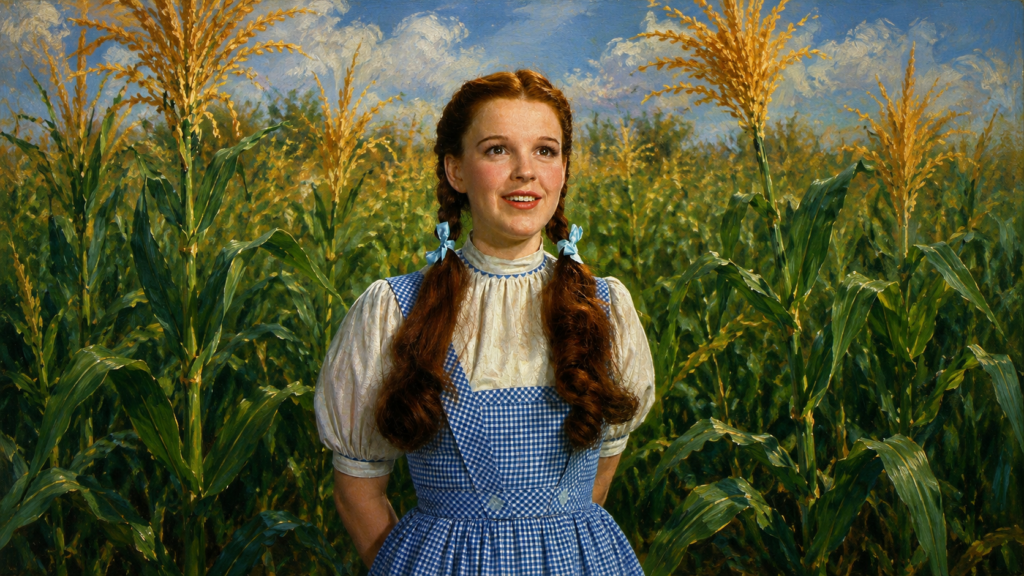
In 1939, the 17-year-old Garland slipped on the ruby slippers and became Dorothy Gale in The Wizard of Oz. The role made her an international icon and remains one of the most beloved performances in cinema history. But the making of that film was anything but magical for the young actress.
MGM executives were obsessed with her appearance. Studio chief Louis B. Mayer reportedly referred to her with humiliating nicknames, and she was placed on punishing diets that severely restricted what she could eat. To play younger characters, including Dorothy, she was made to wear caps on her teeth and prosthetics on her nose. The studio handed her amphetamines, so-called “pep pills,” to boost her energy and suppress her appetite, then gave her barbiturates to help her sleep through exhausting schedules that could stretch for days.
Garland later described the experience with chilling clarity, recalling how the studio gave performers pills to keep them on their feet long after exhaustion had set in, then sent them to the studio hospital to be knocked out. From the age of 13, she said, there was a constant struggle with MGM over food, over her weight, over her body. She would later say she remembered that struggle more vividly than anything else about her childhood. The dependency that would eventually kill her was forged in those years, encouraged and enabled by the very people meant to protect her.
Soaring Highs and Devastating Lows
Across four decades, Judy Garland’s career was a dizzying series of triumphs and collapses. After a string of MGM hits, many alongside fellow teen star Mickey Rooney, she became one of the most bankable performers in Hollywood. She earned two Academy Award nominations and made history as the first woman to win the Grammy Award for Album of the Year, for her electrifying 1961 live recording, Judy at Carnegie Hall.
Her concerts were legendary, raw, emotional, and unforgettable. Yet behind the standing ovations were mounting struggles: failed marriages, financial ruin, and a fragile health that grew more precarious with each passing year. She turned to television with The Judy Garland Show to ease financial troubles, earning four Emmy nominations before the program was canceled after a single season in 1964. By the late 1960s, she was nearly destitute, hounded by tax debts, and sustaining herself on small performance fees.
The Final Curtain
By 1969, Judy Garland’s health had deteriorated dramatically. In early that year she performed a five-week run of shows at the London nightclub The Talk of the Town. Her final concert took place on March 25, 1969, at the Falkoner Centret in Copenhagen, Denmark. That same month, she married Mickey Deans, a discotheque manager twelve years her junior and her fifth husband.
Just three months later, she was gone. Judy Garland was laid to rest, leaving behind three children: Liza Minnelli, Lorna Luft, and Joey Luft. Liza, devastated, later revealed that she cried for eight straight days, unable to believe her larger-than-life mother could truly be gone.
A Legacy That Outshines the Tragedy
It would be easy to remember Judy Garland only through the lens of her suffering, but her own children have pushed back against that narrative. Her daughter Lorna Luft has insisted that while her mother endured tragedies, she herself was not a tragic figure. Her son Joey recalled real joy and fun in their time together. Liza Minnelli has spoken openly about the misconceptions that still cling to her mother’s name, defending the happiness Judy gave her family despite everything.
Nearly three decades after her death, Garland was posthumously honored with a Lifetime Achievement Award at the 1997 Grammy Awards. Her performances continue to find new audiences, and in 2019 her story reached a new generation through the film Judy, with Renée Zellweger earning an Academy Award for her portrayal of the star in her final months.
Judy Garland died at 47, far too soon, worn down by forces set in motion before she was old enough to fight back. But she also lived a life of extraordinary artistry, leaving behind a voice and a presence that time cannot touch. Somewhere over the rainbow, the little girl from Kansas found her way home. And the rest of us are still grateful she ever sang at all.