
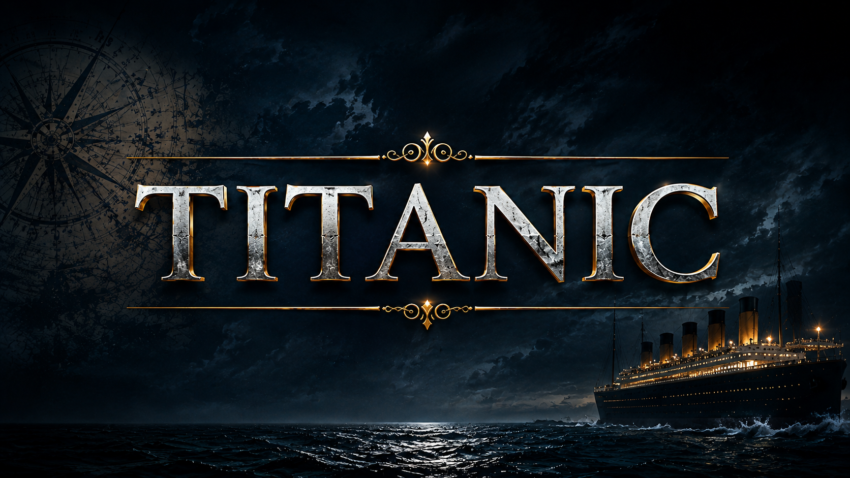
Few films in cinema history have touched the world quite like Titanic. Released in 1997 and directed by James Cameron, the Titanic movie became far more than a disaster film — it became a global emotion, a symbol of love, loss, class struggle, and human tragedy. Decades later, audiences still remember Jack and Rose as if they were real people who lived, loved, and disappeared with the legendary ship.
Jack and Rose: A Love That Crossed Every Class Line
At the heart of the Titanic movie is the unforgettable romance between Jack Dawson, played by Leonardo DiCaprio, and Rose DeWitt Bukater, played by Kate Winslet. Jack is a poor young artist with a free spirit; Rose is a young woman trapped inside the golden cage of high society. Their worlds are completely different, yet their connection feels honest, powerful, and alive. Through them, the film shows that true love can appear in the shortest moments and still last forever.
What makes their story resonate is its simplicity. There are no grand gestures at first — just a hand extended over the railing of a ship, a stranger who refuses to let a young woman give up on her life. From that single moment, Cameron builds one of the most enduring love stories ever put on screen.
Recreating the RMS Titanic Tragedy
What makes the Titanic movie so powerful is not only the romance, but the way it blends a deeply personal story with a real historical tragedy. The sinking of the RMS Titanic in 1912 was one of the most famous disasters of the 20th century, and James Cameron recreated it with breathtaking, almost obsessive detail.
From the luxurious first-class halls to the crowded lower decks, the film shows a world divided by wealth and status — until the ocean makes everyone equally fragile. Cameron’s attention to authenticity, from the ship’s grand staircase to the exact sequence of the sinking, gave the film a sense of realism that few historical epics have ever matched. Audiences weren’t just watching a movie; they were witnessing history brought back to life.
The Performances That Made History
Leonardo DiCaprio’s performance as Jack Dawson turned him into a worldwide icon. Jack was not rich, powerful, or important in society, but he carried the spirit of freedom. He taught Rose how to live, how to breathe, and how to choose her own path. Kate Winslet gave Rose emotional strength and depth, transforming her into far more than a romantic heroine — Rose became a woman fighting to escape a life chosen for her by others.
The supporting cast helped make the film unforgettable. Billy Zane gave Cal Hockley a cold and arrogant presence, the embodiment of control and privilege. Kathy Bates brought warmth and courage as the unsinkable Molly Brown. And Gloria Stuart, as Old Rose, gave the entire story its emotional soul, reminding viewers that memories can outlast time itself. Her narration frames the film as a memory, turning a disaster epic into something intimate and human.
The Heartbreaking Final Act
The final act of the Titanic movie remains one of the most devastating sequences ever filmed. As the ship sinks, the film transforms from romance to survival, from beauty to chaos, from dreams to goodbye. The rising panic, the haunting music, the quiet acts of sacrifice, and the terrible silence after the disaster create an emotional impact that still moves audiences today.
It is here that Cameron’s craft reaches its peak. The terror feels real, but so does the tenderness — the band that keeps playing, the elderly couple holding each other, the mother telling her children a bedtime story as the water rises. These small moments turn statistics into people, and tragedy into something unforgettable.
A Message That Outlived the Ship
One of the greatest strengths of the Titanic movie is its message. The film reminds us that life is short, love is precious, and courage can appear in the darkest moments. Jack and Rose’s story is fictional, but the emotions feel real because they represent something universal: the desire to be loved, to be free, and to be remembered.
More than 25 years after its release, the Titanic movie remains a masterpiece because it speaks to every generation. It is a love story, a tragedy, a historical epic, and a cinematic monument all at once. Many films become popular, but very few become part of people’s hearts.
In the end, Titanic is not just a movie about a ship that sank. It is a movie about a love that survived. The ocean took the ship, but it never took the memory. That is why audiences still watch it, still cry, and still never let go.