
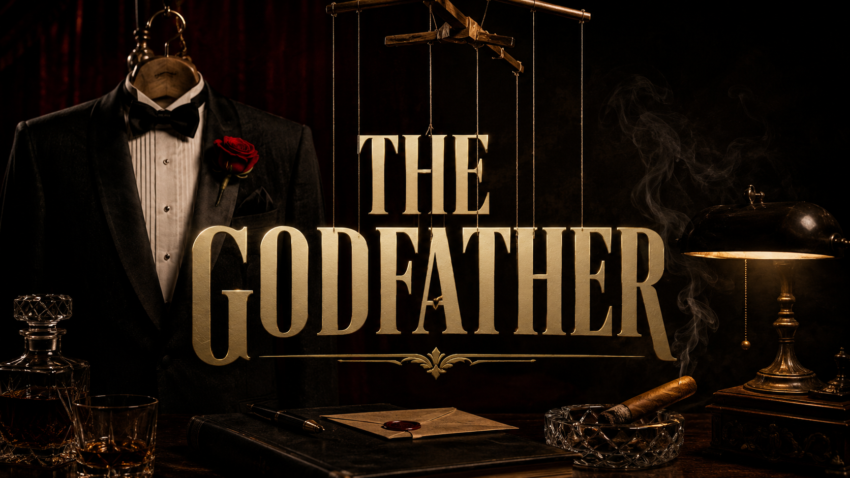
More than half a century after its release, The Godfather remains one of the defining achievements of American cinema.
Francis Ford Coppola’s 1972 film is often remembered for Don Vito Corleone’s intimidating presence, Michael Corleone’s transformation, and lines that became part of popular culture. But reducing The Godfather to a gangster movie misses what makes it endure.
At its heart, the film is about family, loyalty, ambition, inheritance, and the cost of power. Crime provides the setting, but the tragedy of the Corleone family provides the soul.
Its reputation is not simply a product of nostalgia. Paramount describes the film as a 175-minute drama directed by Coppola and based on Mario Puzo’s novel. The studio also records that it received ten Academy Award nominations and won three, including Best Picture.
Decades later, The Godfather continues to command extraordinary respect from filmmakers, critics and audiences. So why has a film released in 1972 remained so powerful?
The Godfather: Essential Facts
Release year: 1972
Director: Francis Ford Coppola
Based on: Mario Puzo’s novel The Godfather
Screenplay: Mario Puzo and Francis Ford Coppola
Running time: 175 minutes
Music: Nino Rota, with Carlo Savina also credited for music scoring
Major cast: Marlon Brando, Al Pacino, James Caan, Robert Duvall, Diane Keaton, John Cazale and Talia Shire
These credits and the 175-minute running time are confirmed by the film’s official Paramount listing.
But statistics alone cannot explain The Godfather. Its greatness becomes clearer when we examine the family at the center of the story.
A Family Story Disguised as a Crime Epic
The Corleones are powerful, feared and deeply involved in organized crime. Yet Coppola introduces them not through a gunfight or a chase, but through a wedding.
That decision tells us almost everything about the film.
Family celebrations, private conversations, favors, traditions and business exist alongside violence. The boundary between the Corleones’ personal and criminal worlds gradually disappears.
Don Vito Corleone is both a father and a crime boss. His authority inside the family cannot be separated from his authority outside it.
And then there is Michael.
At the beginning, Michael Corleone appears to stand apart from his family’s criminal empire. His journey toward its center gives The Godfather much of its tragic force.
The question is no longer simply whether Michael can protect his family.
It becomes: What will protecting that family turn him into?
Michael Corleone’s Transformation Is the Heart of the Film
Al Pacino’s Michael undergoes one of cinema’s most famous character transformations.
He begins as the Corleone son who appears capable of building a life beyond his father’s world. He has served in the military, arrives at the wedding with Kay Adams, and initially seems emotionally separated from the family business.
But circumstances pull him inward.
Coppola does not portray this change as an instantaneous conversion. Michael becomes increasingly calculating and controlled, making each new step feel like the consequence of the one before it.
That gradual transformation is essential.
A lesser film might present Michael as either an innocent hero or a ruthless villain. The Godfather allows him to become something more unsettling: a man whose intelligence, loyalty and desire to protect his family become intertwined with his capacity for violence and domination.
By the end, the distance between Michael and the world he once seemed to reject has dramatically narrowed.
Marlon Brando Created an Iconic Don Vito Corleone
Marlon Brando’s performance as Don Vito Corleone became one of the film’s defining elements.
His Don is not powerful because he constantly raises his voice. Much of his authority comes from restraint. He listens. He pauses. He speaks quietly while everyone around him understands the consequences of ignoring him.
That makes the character more intimidating, not less.
Paramount specifically identifies Brando’s performance as Oscar-winning and describes him as the patriarch of the Corleone family.
The performance also gives Vito humanity. He can be affectionate toward his family while remaining the leader of a violent criminal organization.
That contradiction is central to the film.
Coppola never requires the audience to pretend the Corleones are morally innocent. Instead, he shows how affection, tradition and brutality can exist within the same people.
The Supporting Cast Is One of the Film’s Greatest Strengths
Although Brando and Pacino dominate discussions of The Godfather, the film depends on an extraordinary ensemble.
James Caan brings volatility and physical energy to Sonny Corleone. Robert Duvall gives Tom Hagen a quieter intelligence and professionalism. John Cazale makes Fredo vulnerable in ways that would become increasingly important to the larger Corleone saga.
Diane Keaton’s Kay Adams is particularly significant because she gives viewers a perspective partly outside the Corleone world.
Through Kay, we can see how extraordinary that world actually is.
Talia Shire’s Connie Corleone also helps reveal the painful consequences hidden beneath the family’s public celebrations and traditions.
Paramount’s official cast listing confirms the central ensemble, including Brando, Pacino, Caan, Cazale, Duvall, Keaton and Shire.
The result is a film in which even characters outside the central father-and-son relationship contribute to the larger portrait of the family.
Why The Godfather Looks So Distinctive
The film’s visual identity is inseparable from its atmosphere.
Dark interiors, carefully controlled compositions and faces partially surrounded by shadow create a world in which information is rarely completely exposed.
That visual darkness suits a story built around secrecy and power.
The contrast between environments is equally important. Family gatherings can feel warm and alive, while closed rooms used for negotiations feel controlled and claustrophobic.
The camera does not need constant movement to create tension.
Often, Coppola allows characters to sit, listen and negotiate.
The audience is forced to pay attention to who has power in the room—and who only thinks they do.
This patience is one reason the movie can feel so different from faster modern crime films. Its tension often comes from anticipation rather than immediate action.
Violence Has Consequences
The Godfather contains memorable violence, but violence is not treated merely as spectacle.
It changes relationships.
It creates retaliation.
It forces characters to make decisions from which they cannot easily return.
That structure helps the movie avoid becoming a simple collection of gangster confrontations. Actions create consequences, and those consequences reshape the Corleone family.
This is especially important to Michael’s story. Each escalation makes his previous identity increasingly difficult to recover.
Nino Rota’s Music Became Part of the Film’s Identity
The music of The Godfather is as recognizable as many of its performances.
Paramount credits Nino Rota and Carlo Savina for music scoring.
Rather than simply making the criminal world sound dangerous, the score frequently gives the story a mournful, almost nostalgic quality.
That choice matters.
The music reminds us that beneath the power struggles lies a story about family, memory and loss. It contributes to the feeling that we are watching not merely the rise of an empire, but the deterioration of something personal.
The Film’s Greatest Theme: The Price of Power
Perhaps the most important idea in The Godfather is that power always carries a price.
The Corleones seek security through influence. Violence is justified as protection. Loyalty is treated as a virtue.
Yet the more power the family accumulates, the more difficult genuine trust becomes.
Michael embodies this contradiction.
His growing authority makes him stronger in one sense while isolating him in another.
This is why the film remains dramatically compelling even for viewers with no particular interest in gangster stories.
Its central questions are universal:
How much can someone sacrifice in the name of family before the sacrifice destroys the very relationships they hoped to protect?
And:
Can a person enter a corrupt system to control it without eventually being transformed by it?
Those questions remain relevant long after the details of the plot are over.
The Godfather’s Place in American Film History
The film’s reputation is backed by more than popular memory.
The Library of Congress lists The Godfather as having been inducted into the National Film Registry in 1990. The Registry exists to recognize and preserve significant parts of American film heritage.
Its reputation also continues among major filmmakers.
At the 2025 AFI Life Achievement Award ceremony honoring Francis Ford Coppola, Steven Spielberg described The Godfather as, in his view, “the greatest American film ever made.”
That praise arriving more than five decades after the film’s premiere illustrates something important: The Godfather has not merely survived as an artifact of the 1970s. It continues to function as a reference point for filmmakers discussing American cinema itself.
Why New Generations Still Discover The Godfather
Some classics survive primarily because they are historically important.
The Godfather has another advantage: it remains dramatically accessible.
Viewers can approach it as a crime story, a family tragedy, a character study, a story about immigration and assimilation, or an examination of power.
Different generations can therefore discover different things inside the same film.
A first viewing might be dominated by Don Vito.
A later viewing may make Michael more fascinating.
Another might reveal how important Kay, Tom, Sonny, Connie or Fredo are to understanding what the Corleone family gains—and loses.
That richness gives the film unusual replay value.
More Than a Gangster Movie
Calling The Godfather one of the most important gangster films ever made is accurate, but incomplete.
Its lasting achievement is the way Francis Ford Coppola and his collaborators transformed a story about organized crime into a much larger tragedy about family and power.
Marlon Brando created an unforgettable patriarch. Al Pacino gave the film its devastating transformation. The supporting cast made the Corleones feel like a complicated family rather than pieces in a crime plot. The cinematography and music gave their world an identity that remains instantly recognizable.
And history has reinforced that reputation: the film won Best Picture, entered the National Film Registry, and continues to receive extraordinary praise decades after its release.
More than fifty years later, The Godfather does not endure simply because audiences remember it.
It endures because audiences can still return to it and find something worth examining.