
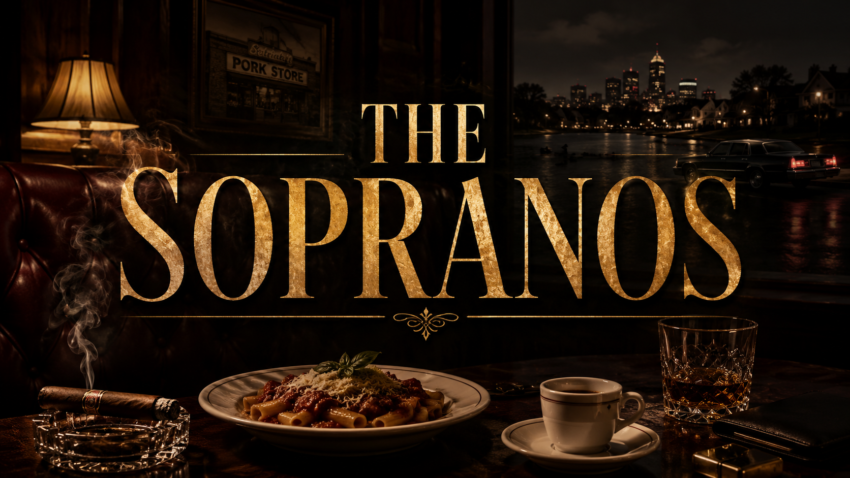
Few television dramas have influenced modern storytelling as profoundly as The Sopranos. Created by David Chase and originally broadcast on HBO from 1999 to 2007, the series transformed a familiar crime-story premise into something far more ambitious: an intimate examination of family, power, anxiety, loyalty, violence and the contradictions of American life.
At the center of the story is Tony Soprano, played by James Gandolfini, a New Jersey mob boss attempting to manage two demanding families at once. One is his criminal organization. The other is his wife, children, mother and relatives.
Yet Tony is struggling internally. Panic attacks eventually bring him to psychiatrist Dr. Jennifer Melfi, creating the relationship that gives The Sopranos much of its distinctive psychological depth.
That combination — organized crime and psychotherapy — helped produce a television protagonist unlike the conventional heroes that had dominated American television.
Years after the finale, the series remains enormously important to television history. The Writers Guild of America ranked The Sopranos No. 1 on its list of the 101 Best Written TV Series, describing the series as a major force in television’s storytelling renaissance.
What Is The Sopranos About?
The Sopranos follows Tony Soprano as he attempts to maintain authority in New Jersey’s organized-crime world while dealing with an increasingly complicated private life.
His criminal responsibilities require intimidation, secrecy and sometimes extreme violence. At home, however, Tony faces problems that money and power cannot easily solve.
His marriage to Carmela Soprano is complicated by infidelity, resentment, affection and the moral consequences of the lifestyle supporting their family. Meanwhile, their children, Meadow and A.J., gradually develop their own understanding of who their father really is.
Then there is Tony’s relationship with his mother, Livia, one of the most difficult and psychologically important relationships in the early series.
Rather than presenting these conflicts separately, The Sopranos constantly allows them to collide. A criminal dispute can affect Tony’s home life, while a seemingly ordinary family problem can expose something much darker about his personality.
Tony Soprano and the Rise of the TV Antihero
Tony Soprano became one of television’s defining antiheroes because the series never reduces him to either a traditional villain or a misunderstood hero.
He can be charismatic, funny and surprisingly vulnerable. He loves his children and can demonstrate genuine affection toward people around him.
However, he is also violent, manipulative, unfaithful and capable of terrible decisions.
That contradiction is essential.
Instead of asking viewers simply to support Tony, The Sopranos repeatedly forces them to reconsider why they find him compelling in the first place. The Writers Guild later highlighted this kind of morally complicated protagonist when discussing the rise of television antiheroes and the medium’s increased focus on character psychology.
James Gandolfini’s performance makes those contradictions believable. Small changes in his expression, voice and physical presence can move Tony from charming to threatening within moments.
As a result, Tony Soprano became more than the protagonist of a crime drama. He became a model for the psychologically complex television characters that followed.
The Sopranos and Dr. Jennifer Melfi
One of David Chase’s most important creative decisions was putting a mob boss in therapy.
Tony begins seeing psychiatrist Dr. Jennifer Melfi, played by Lorraine Bracco, after experiencing panic attacks. Their conversations allow the series to examine Tony’s fears, childhood, relationships and behavior without turning therapy into a simple explanation for everything he does.
The sessions also create a fascinating conflict.
Tony wants relief from his psychological problems, but genuine change would require confronting aspects of himself that he is often unwilling to abandon.
Melfi, meanwhile, must deal with the ethical and emotional consequences of treating a patient whose life includes serious criminal violence.
Their conversations became one of the show’s defining storytelling devices and helped distinguish The Sopranos from conventional gangster dramas.
The Soprano Family
The title The Sopranos has a deliberate double meaning.
Tony’s criminal associates form one family, while Carmela, Meadow and A.J. form another. His struggle to maintain control over both drives much of the series.
Carmela Soprano, played by Edie Falco, is particularly important because she understands where the family’s comfortable lifestyle comes from.
She loves Tony, but she is also forced to confront his repeated betrayals and the moral compromises surrounding their wealth.
Meadow, played by Jamie-Lynn Sigler, becomes increasingly independent as she grows older. A.J., played by Robert Iler, follows a different and often more troubled path.
Consequently, The Sopranos works not only as a crime series but also as a complicated family drama.
The Criminal World of The Sopranos
Tony’s other family includes some of the show’s most memorable characters.
Christopher Moltisanti, played by Michael Imperioli, is Tony’s younger associate and relative whose ambitions extend beyond organized crime.
Silvio Dante, played by Steven Van Zandt, serves as a trusted adviser. Paulie Gualtieri, portrayed by Tony Sirico, combines loyalty, paranoia, violence and dark comedy in a way that made him one of the show’s most recognizable supporting characters.
Other important figures enter and leave Tony’s world as alliances shift and conflicts grow.
What makes this criminal environment distinctive is its lack of romantic perfection.
The characters worry about money, status and respect. They argue over relatively small matters. They misunderstand each other. Some are insecure, petty or incompetent.
The mob is dangerous, but The Sopranos also portrays it as an organization populated by flawed human beings rather than glamorous mythical gangsters.
Why The Sopranos Felt Different
Earlier gangster films had already established many of the genre’s most recognizable conventions. The Sopranos understood those traditions but approached them from another direction.
The series could move from murder and organized crime to a family dinner, therapy appointment or suburban argument without making those quieter scenes feel unimportant.
Comedy also plays a surprisingly large role.
Some of the funniest moments emerge from misunderstandings, personality clashes and the absurdity of characters attempting to maintain dignity while behaving irrationally.
This mixture of crime, family drama, psychology and dark comedy gave the series a tone that was difficult to categorize.
More importantly, the show trusted audiences to live with ambiguity.
Characters did not always explain themselves. Conflicts were not necessarily resolved neatly. Symbolism, dreams and apparently mundane conversations could carry significant meaning.
The Writing That Changed Television
David Chase originally conceived the central idea around a mobster dealing with problems involving his mother, and the concept eventually developed into The Sopranos. The Writers Guild notes this origin in its retrospective on the series.
Over time, the premise expanded far beyond organized crime.
The writers explored marriage, parenthood, masculinity, depression, consumer culture, identity, aging and changing American institutions.
That ambition eventually received one of the industry’s strongest forms of recognition.
In 2013, members of the Writers Guild of America voted The Sopranos the best-written television series on its list of 101 programs, ahead of Seinfeld, The Twilight Zone, All in the Family and M*A*S*H.
James Gandolfini’s Defining Performance
It is difficult to separate The Sopranos from James Gandolfini.
His Tony Soprano needed to exist simultaneously as a suburban father, husband, patient and feared criminal leader.
Gandolfini made each side convincing without making the contradictions disappear.
Tony’s physical presence could dominate a room. Nevertheless, therapy scenes often revealed insecurity, anger, fear and emotional confusion underneath that authority.
The performance helped demonstrate how much psychological complexity a long-form television character could sustain.
Instead of completing a traditional transformation over two hours, Tony could evolve — and sometimes resist evolution — across years of storytelling.
Edie Falco and Carmela Soprano
Carmela could easily have become a secondary character defined only as Tony’s wife. Instead, Edie Falco helped make her one of the show’s essential figures.
Carmela enjoys the security Tony’s money provides while understanding that the source of that wealth is morally compromised.
Her relationship with Tony therefore becomes one of the series’ most complicated conflicts.
Love, anger, religion, financial dependence, jealousy and self-deception all coexist within the marriage.
Through Carmela, The Sopranos examines an important question: how much responsibility belongs to someone who benefits from wrongdoing without directly committing the crimes?
The series rarely provides an easy answer.
Awards and Critical Recognition
The influence of The Sopranos was accompanied by substantial industry recognition.
Its writing, acting, directing and overall production received extensive awards attention during its original run. James Gandolfini and Edie Falco were particularly celebrated for their performances, while the series itself became a major presence at television awards ceremonies.
More importantly, its reputation survived the end of its original broadcast.
The Writers Guild’s later decision to rank it first among the 101 Best Written TV Series demonstrates how strongly its storytelling continued to resonate with television writers years after the finale.
How The Sopranos Influenced Modern Television
Perhaps the greatest legacy of The Sopranos is visible in the television that followed it.
The series demonstrated that audiences could remain invested in a protagonist who was deeply flawed and sometimes morally repellent.
It also showed the potential of serialized television for sustained psychological storytelling.
Later prestige dramas would increasingly embrace complicated protagonists, cinematic production, long-running character development and morally ambiguous worlds.
That does not mean every later antihero drama simply copied The Sopranos. However, the series helped expand what television creators and audiences believed a drama could accomplish.
The Writers Guild goes even further, arguing that no show was more responsible for television’s storytelling renaissance.
The Sopranos Finale
Few television endings have generated as much discussion as the finale of The Sopranos.
Rather than providing a conventional conclusion in which every major question receives an explicit answer, David Chase ended the series with deliberate ambiguity.
That choice divided viewers when the episode originally aired and has inspired interpretation ever since.
Yet the ending also fits the storytelling philosophy of the series.
The Sopranos frequently resisted simple moral judgments and tidy resolutions. Therefore, an ending that forces viewers to interpret what they have seen feels consistent with the show’s larger approach.
Explaining every possible interpretation would also remove part of what makes the finale so enduring.
Its power comes from what the audience sees, what it expects to happen and what the series ultimately refuses to state directly.
Why The Sopranos Still Matters
The technology and television industry surrounding The Sopranos have changed dramatically since the series premiered in 1999.
Its central subjects, however, have aged differently.
Family conflict, ambition, anxiety, self-deception, money, loyalty and the desire for control remain recognizable themes.
The series is also unusually rewarding to revisit because many scenes operate on several levels simultaneously. A conversation that initially appears humorous can reveal a character’s insecurity. A domestic argument can mirror a criminal power struggle. A therapy session can raise questions that are not answered until much later — if they are answered at all.
That density helps explain why discussion of the series has continued long after its finale.
The Legacy of The Sopranos
Calling The Sopranos merely a gangster series misses much of what made it extraordinary.
Organized crime provides the world of the story, but human behavior is its real subject.
David Chase and his collaborators used Tony Soprano’s life to examine the distance between how people see themselves and how they actually behave.
James Gandolfini gave that idea an unforgettable human center. Edie Falco, Lorraine Bracco, Michael Imperioli and the wider ensemble then built a world around him that could be frightening, tragic and unexpectedly funny.
Its influence can be debated and its famous ending can still divide audiences. Its historical importance, however, is difficult to dismiss.
More than a decade after the finale, the Writers Guild of America placed The Sopranos at the very top of its ranking of television writing.
Ultimately, that may be the clearest description of its legacy: The Sopranos did not simply become one of television’s most acclaimed dramas.
It helped change what television drama could be.